
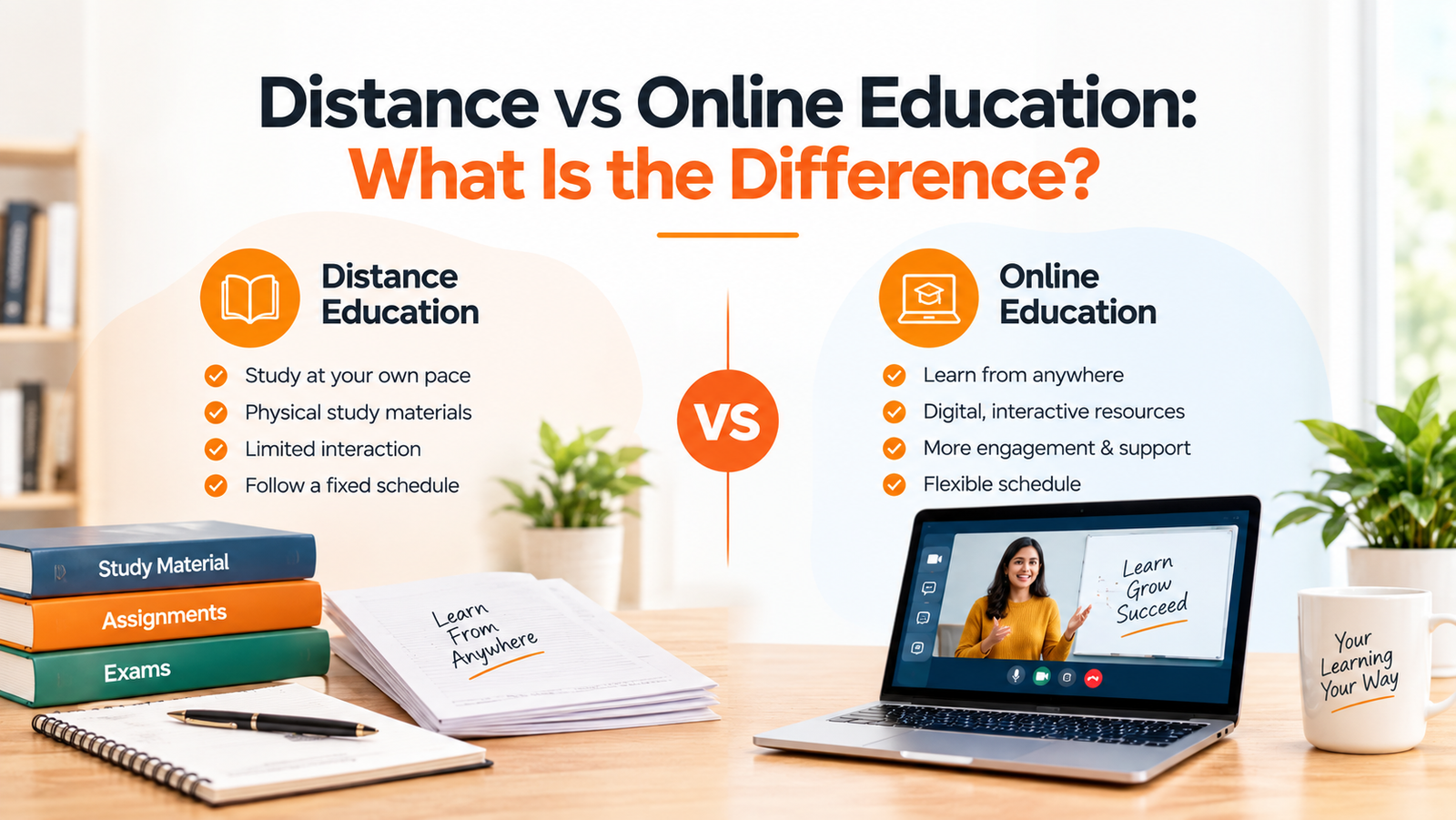
Most articles answer “distance vs online education” by describing the student experience — printed material versus video lectures, occasional classes versus live sessions. That’s true, but it skips the actual legal distinction that decides which universities you can even enrol with, and from where. This guide covers both — the regulation that actually governs the difference, and what it means practically for your choice.
Most Explanations of This Get the Core Difference Wrong
The common explanation is that distance education is “old-school” (printed material, physical exams) while online education is “modern” (digital, live classes). That framing isn’t wrong, but it misses the one distinction that has real legal consequences: where you’re allowed to enrol from.
They’re Actually Governed by the Same Regulation — With One Critical Split
Since 2020, both modes fall under a single unified rulebook — the UGC (Open and Distance Learning Programmes and Online Programmes) Regulations, 2020 — which replaced two earlier, separate regulations (one for ODL from 2017, one for online courses from 2018). So Open & Distance Learning (ODL) and Online Learning (OL) aren’t two entirely separate legal categories anymore; they’re two modes recognised under the same framework, with different conditions attached to each.
The Territorial Jurisdiction Rule (The Difference That Actually Matters Legally)
This is the part almost no student-facing article explains clearly: under the regulations, a university offering a programme in ODL (distance) mode must conduct all its activities — admissions, contact programmes, examinations — strictly within its specified territorial jurisdiction, usually the state or region the university is registered in. In practice, this means some distance programmes are legally restricted to students from, or willing to attend centres within, a defined geographic area.
Online programmes have no such territorial restriction. A UGC-recognised online programme can enrol learners from anywhere in the country, which is exactly why online mode has become the preferred route for students who don’t live near a university’s home state but want its specific programme.
If you’ve ever wondered why a particular distance programme seemed to prioritise or restrict applicants from certain states, this jurisdiction rule is usually the reason — worth checking directly with the university before assuming you’re eligible.
Delivery Format: Learner Support Centres vs Fully Digital
ODL programmes are required to maintain Learner Support Centres (LSCs) — physical locations that provide study material, occasional contact classes, and administrative support within the university’s jurisdiction. Online programmes are not bound by this same physical-centre requirement and are delivered through a fully digital learning platform, self-learning material (SLM), and e-content — a structurally different delivery obligation, not just a stylistic choice by the university.
Exam Format: Centre-Based vs Proctored Online
Distance/ODL programmes typically require students to appear for term-end examinations at a designated physical centre. Online programmes, under the same set of regulations, are permitted to use proctored online examinations — meaning the exam itself can be taken remotely under monitored conditions, without travelling to a centre. This is one of the most practically significant differences for a working professional weighing the two modes.
Are the Degrees Equally Valid? What UGC Actually Says
Yes. Degrees and postgraduate diplomas awarded through either ODL mode or Online mode by a UGC-recognised institution are treated as equivalent to the corresponding degrees awarded through conventional, on-campus mode. Neither mode is legally “lesser” than the other — validity depends entirely on the awarding institution’s current recognition status for that specific programme, not on which of the two modes it was studied through.
Can You Switch Between the Two Modes?
Interestingly, yes, under specific conditions — the regulations allow learner mobility from one mode to another within the same recognised institution, subject to the university’s own approved provisions and statutory approval. This isn’t automatic or guaranteed across every university, but it’s worth asking about directly if your circumstances (say, a job relocation) might require a switch partway through your programme.
Distance vs Online — Quick Reference Table
| Factor | Distance (ODL) | Online |
| Geographic enrolment | Restricted to university’s territorial jurisdiction | No territorial restriction — nationwide |
| Physical infrastructure requirement | Learner Support Centres (LSC) mandatory | Fully digital delivery, no LSC requirement |
| Exam format | Typically centre-based, in-person | Proctored online examinations permitted |
| Legal validity | Equivalent to conventional degree (if recognised) | Equivalent to conventional degree (if recognised) |
| Mode switching | Possible within same institution, per its provisions | Possible within same institution, per its provisions |
How EDUCATION SOLUTIONS SERVICES Helps You Pick the Right Mode
Territorial jurisdiction rules, LSC access, and exam format aren’t always explained clearly on a university’s own admissions page — and getting this wrong can mean discovering mid-application that you’re not eligible to enrol in a specific distance programme from your state. At EDUCATION SOLUTIONS SERVICES, we check these details upfront across the distance and online universities we work with. Talk to our career counselling team to confirm which mode you’re actually eligible for before you apply.
